
Categories
Blog

How an ACA Repeal Would Harm Texans

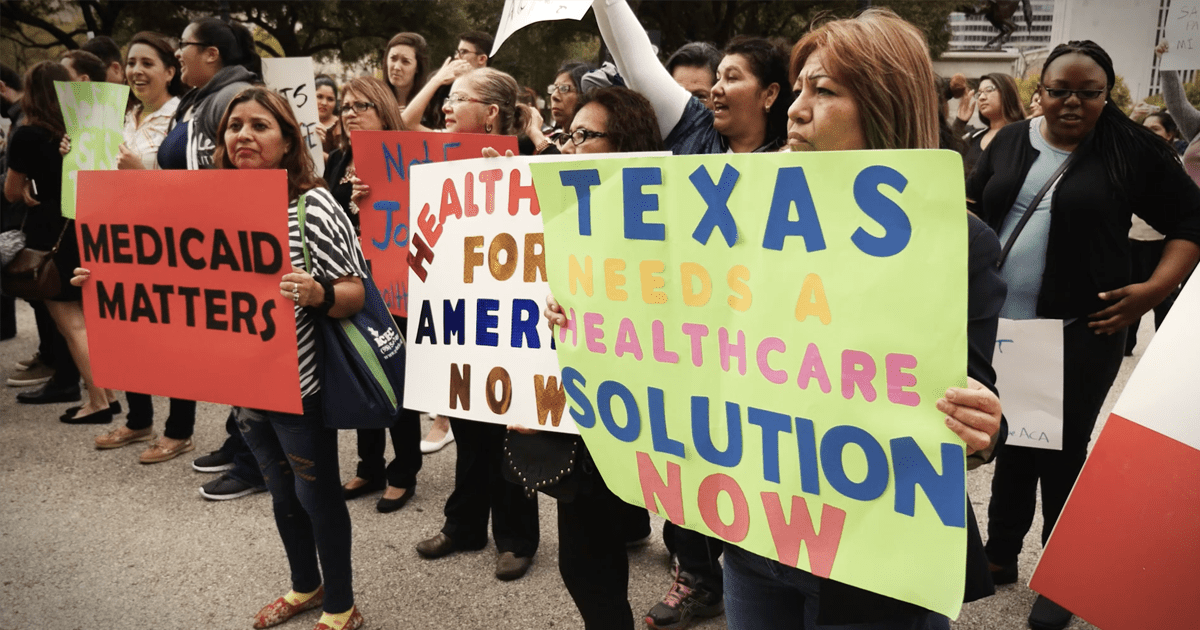
With the Affordable Care Act (ACA) Open Enrollment deadline just one week away, it’s important to outline how important the landmark health law has been for Texans. Over 1.1 million Texans have selected plans in the health insurance Marketplace so far, with 27 percent of them being new to the Marketplace this year. 
In our new fact sheet, we outline how dangerous a repeal of the ACA by Congress would be for Texas, especially without immediate replacement. Remember that in the first U.S. Senate debate and vote to set Congress on a repeal pathway, numerous Senators cautioned—including a number of Republican officials—that an ACA repeal without replacement is not an option. Agreeing on a replacement plan, they argued, will likely take time.
CPPP held a briefing at the Texas Capitol on January 24 to go over these threats to Texas. Watch a recording of the presentation here, and view the slides here.
Here are some of the challenges Texas could face if Congress repealed the ACA without giving Texans any other options:

  1. Loss of Coverage, Collapse of Individual Marketplace. Over 900,000 Texans get sliding-scale discounts that cut their health insurance premiums by an average of 75 percent, and without those discounts most will drop coverage.  Coverage for another 900,000 insured unsubsidized Texans would also be in jeopardy.  Insurance experts predict collapse of the individual (direct-purchase) Health Insurance Marketplace is likely with either a full repeal or “repeal and delay.”  The American Academy of Actuaries has warned Congress that repealing major provisions of the ACA (even a repeal with a delay), or eliminating subsidies, could result in significant market disruption leading to millions of Americans losing health insurance.  Economists from the conservative American Enterprise Institute have raised the same concerns.
  2. Yearly or lifetime caps. If you have a serious injury or illness, you could hit a yearly or lifetime dollar cap, and have no more insurance coverage. Before the ACA, Texans with serious conditions like hemophilia, Crohn’s disease, cancers, or who needed organ transplant had coverage that stopped paying their bills at some point, leaving them scrambling for care, compromising their health and often causing financial ruin.  About 5 million insured Texans had a lifetime limit on their insurance policy before the ACA.
  3. Mental health coverage. Coverage of mental health needs or substance use disorder treatments could be dramatically reduced. Equal treatment for mental health and substance use disorder conditions—known as “mental health parity protections”—would be dramatically reduced with ACA repeal.  The ACA extended mental health parity to cover more insured Texans, and repeal would mean millions of Texans would lose protection of equal access to mental health benefits in insurance.
  4. Women could be unable to buy insurance that covers maternity, and could once again be charged more than men. Before the ACA ended gender discrimination in health coverage pricing, women in Texas were charged as much as 56 percent more than men for the same coverage (even with maternity benefits excluded).  Before the ACA, women literally could not purchase coverage on the individual market that covered pregnancy—and not just after a women got pregnant.  Insurers in Texas simply did not sell non-group policies that included maternity care.

Read more in our full policy brief here.
Categories
Presentation

High-Stakes Health Care – Essentials on the Affordable Care Act, Medicaid and CHIP in a Trump Administration

Categories
Report

Put on the Brakes, Congress! The Damage in Texas if Congress Repeals the Affordable Care Act without an Immediate Replacement

Categories
Presentation

Poverty and Income in Texas- Findings from the 2015 American Community Survey

Categories
Blog

Groups Urge State Leaders to Protect Health Care for All Texans

Earlier this month, leaders from the U.S. House of Representatives sent a letter to all governors and state insurance commissioners requesting input on potential changes to the Affordable Care Act (ACA) and Medicaid. The U.S. Senate Committee on Finance sent a separate letter seeking similar input to members of the Republican Governor’s Association.
As Congress prepares to take up federal health care laws, the Cover Texas Now coalition submitted a detailed letter to Governor Abbott, and Texas Insurance and Health and Human Services Commissioners Mattax and Smith, urging them to voice support for policies that will create a more stable, affordable, and high-quality health care system that builds on recent progress, while making improvements.
Cover Texas Now is opposed to:
• Congress repealing the ACA without simultaneously passing a replacement plan that would ensure no loss of coverage or loss of consumer protections, and
• Congress fundamentally altering and reducing federal funding for Medicaid, either through a block grant or per capita cap.
Cover Texas Now is a coalition of consumer and faith-based organizations that desire to see the state of Texas implement a sustainable health care system and provide quality affordable health coverage to its citizens.

Categories
Infographic

What is a Surprise Medical Bill? (Infographic)

Categories
Blog

What’s Next for the Affordable Care Act?

Given the results of the national election, we know that many people concerned with Texans’ access to quality health coverage under the Affordable Care Act are uncertain about the future availability of coverage.
It’s too early to predict what policy changes Texas and the rest of the country might see, but here are some things to remember:
*Open enrollment for 2017 under the Affordable Care Act continues. If you enroll by December 15th, your coverage will begin January 1st.
*We do not expect a rapid change that would leave millions without coverage or care in 2017. Such a drastic change would hit the insurance industry and health care providers hard as well. One of the hallmarks of our American political system is the peaceful transition of power. Sweeping, overnight changes are not the norm in U.S. government.
*While we must wait for more details of the new administration’s healthcare plan, the president-elect’s campaign platform called for “repeal & replace.” As a candidate, he said indicated that he wants every American to be covered.
*Increasing access to health care for all Texans remains a core value for all of us who work in the health sphere. We will continue to advocate for consistent access to affordable preventive, primary, and specialty care for all.
Our primary focus at this moment is continues to be on ensuring that Texans know what their options are for affordable coverage for 2017.
As a consumer advocacy organization that fights every day to make sure that Texans have a say in decisions that affect their health, the Center for Public Policy Priorities encourages you to share your support for the Affordable Care Act with your public officials. Go to www.covertexasnow.org to learn more.

Categories
Presentation Testimony

Legislative Testimony- House Higher Education

Categories
Testimony

Letter to the Texas Health and Human Services Commission regarding Zika

Categories
Blog

Texas Medicaid Expansion and Coverage Gap Estimates Need Some Updating

We get a lot of “numbers” questions: about uninsured Texans, and Texas Medicaid, and about how many could get covered if our state accepted federal dollars allocated to cover our low-income adults.  One challenge is that the numbers keep changing over time.  This blog post launches our latest updated estimates of the number of uninsured Texans who could gain coverage if our state implements Medicaid Expansion coverage, and the subset of that number who are in the Coverage Gap.
Did I lose you already?  Stay with me, we can do this. Really.
The newest U.S. Census data estimate that 5 million Texans were uninsured in 2014.  That’s across all incomes, and it captures only the very first year of expanded private and public coverage under the ACA (i.e., Marketplace coverage and Medicaid Expansion).  That’s a drop—for the first time in many years—of over 700,000 uninsured and three percentage points from 2013 (from 22.1 to 19.1 percent).
Medicaid expansion—whether through traditional Medicaid, or under an alternative approach with more conservative features—covers adults up to 133 percent of the federal poverty income level, which is about $26,800 annual income for a family of three in 2016 (and yes, Congress updates these poverty income guidelines every year).
Because the number of uninsured Texans dropped in 2014, so did the number of uninsured Texans who would qualify for Medicaid coverage, if Texas made it available.  For 2014, about 1.5 million of the 5 million uninsured Texans are estimated to be U.S. citizen adults (mostly working) who could qualify for Medicaid under an expansion.  (Estimate based on U.S. Census estimates and Kaiser Family Foundation models that adjust to exclude uninsured undocumented immigrants, who are ineligible for Medicaid.)
Uninsured Texans who could get Medicaid Expansion, and the subset in the Coverage Gap
We also need to update the number of uninsured in the Coverage Gap subset of Medicaid Expansion: Texas adults with incomes under the federal poverty income level ($20,160 annual income for a family of three in 2016).  They are referred to as the Coverage Gap groups, because they are excluded under federal law from Marketplace subsidies.  (In contrast the adults between 100-133% FPL can get Marketplace insurance at a very low subsidized sliding-scale rate.)  Using the same model as the larger Medicaid Expansion group, about 864,000 of the potential Medicaid Expansion population are estimated to have incomes below the poverty line, are ineligible for both subsidies or Medicaid, and in the Coverage Gap.
The Weeds:  Don’t Even Read This Unless You Like Details!  For these estimates, we have used estimates from a national expert source, the Kaiser Family Foundation (KFF), to model the size of the potential full Medicaid Expansion group and the below-poverty subset in the Coverage Gap.  We use KFF’s proportions (derived from the Census’ Current Population Survey), and the U.S. Census’ estimated Texas uninsured population finding from the American Community Survey to produce the rough estimates.
Why so complicated?  “Raw” unadjusted Census numbers would include non-U.S. citizen adults, who are excluded from a Medicaid Expansion.  The KFF model is carefully designed to eliminate the ineligible non-citizens from the data, so using their proportions helps us more accurately estimate the number of potentially eligible U.S. citizen adults.
More Updates Will Come.  CPPP will be updating our county data tools soon to reflect these revised estimates.  The numbers in the table generator and infographics were produced before the 2014 Census data were available.  And we apologize in advance, but as soon as the next round of Census data comes out (which will reflect the coverage changes in 2015), we will update them again.
To sum up, here are Texas-level rough estimates: