Categories
Factsheet

Children’s Health Insurance Program (CHIP) Essential Care, Designed for Texas Children

Categories
Executive Summary Report

Consequences of the Texas Public School Funding Hole of 2011-16 – Executive Summary

Categories
Blog

Gap between Texas and U.S. in Health Coverage Continues to Widen, Census Shows

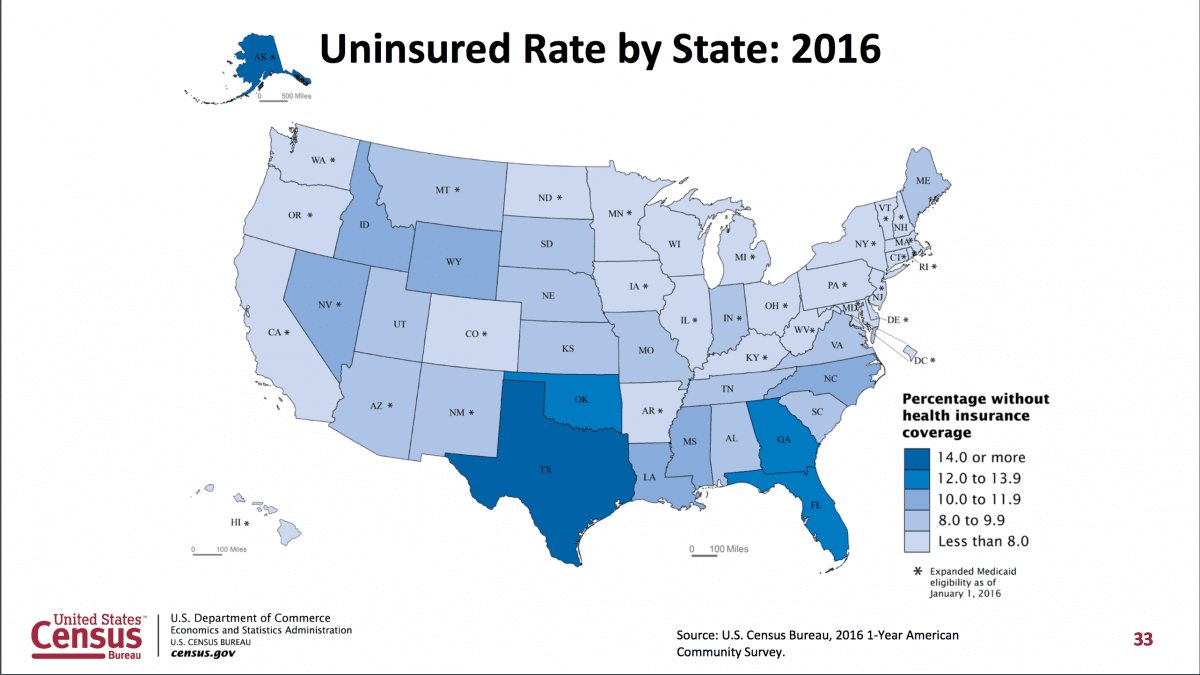
Today’s U.S. Census data release confirms that the number of Texans without health insurance continued to decline in 2016, with uninsured Texans dropping by 70,000 from the 2015 number, and by over 1.2 million since 2013.  But despite the progress, Texas still has both the largest number (4.5 million) and percentage (16.6 percent) of uninsured residents in the country.
Today’s release of the Current Population Survey (CPS) by the U.S. Census, including a sneak preview of health insurance data from the American Community Survey (ACS), provides the third year of Census data showing how much health insurance coverage has grown since the launch of new private and public coverage options under the ACA in 2014.  Nationally and in Texas, uninsured rates dropped by smaller margins from 2015 to 2016 than in the first two years of ACA coverage implementation.
“We are really pleased to see that in 2016, the Affordable Care Act continued to boost health insurance coverage in Texas,” said CPPP Associate Director Anne Dunkelberg. “But too many hard-working, low-income Texans are still left uninsured, and the long-lasting effects of Hurricane Harvey have now created new need among Texas families. Today’s release underscores the need for both rapid health care relief for those affected by Harvey, and long-term solutions to provide free or low-cost health coverage to a newly-enlarged population of poor and low-income working families. All Texans will see health benefits and cost savings if Texas follows the lead of the majority of states – including very conservative states –by expanding coverage for these families using federal Medicaid dollars.”
Today’s Texas highlights from the Census Bureau’s Uninsured data:
*Texas saw another year of improvement in our overall (all ages) uninsured number and rate:
**2013 = 5.7 million Texans (22.1 percent)
**2014 = 5.0 million Texans (19.1 percent)
**2015 = 4.6 million Texans (17.1 percent)
**2016 = 4.5 million Texans (16.6 percent)
Note: Percentage declines in 2016 are statistically significant changes from 2013, 2014 and 2015.
*The Census findings for 2016 add to the important gains we saw in for 2014 and 2015. From 1999 to 2013, Texas’ uninsured rate fluctuated between 21 and 25 percent, and we never had a one-year improvement of even a full percentage point. But since 2013, our state’s uninsured rate has dropped a total of 5.5 percentage points, with 1.2 million fewer uninsured Texans since new ACA coverage options started up in 2014.
*Texas again had a notably smaller improvement in health care coverage than did states that have expanded Medicaid to cover below- and near-poverty adults. New Mexico’s uninsured rate was cut in half from 18.6 percent in 2013 to 9.2 percent in 2016 (a drop of 9.4 percentage points); Louisiana dropped from 16.6 percent uninsured to 10.3 percent; and Kentucky improved from 14.3 percent in 2013 to 5.1 percent in 2016, (a huge drop of 9.2 percentage points).
*The main source of coverage gains in the U.S. and Texas since 2013 has been direct purchase of insurance by individuals and families, including through the ACA marketplace or directly from an insurer (direct purchase coverage grew by 4.8 percentage points for the U.S., about 16.2 million Americans). Medicaid coverage was the second largest source of gains nationally (nationally, coverage under Medicaid grew 1.9 percentage points, by about 7.4 million Americans).
*States that did some form of Medicaid expansion showed larger improvements in their uninsured rates for working-age adults (18-64) than Texas did. This is because non-Medicaid expansion states like Texas cover only a fraction of parents, and cover no uninsured adults without dependent children at home (unless over 65 or disabled, and in poverty). About 23 percent of working age Texans (ages 18 to 64) were uninsured in 2016, compared to a U.S. average of 12.1 percent. Census analysts report that in non-Medicaid expansion states, the uninsured rate for adults in poverty is almost twice the rate found in states with a coverage expansion for the working poor.
*Texas remains the state with both the largest percentage and the highest number of uninsured residents. Prior to 2014, California was the state with the largest number of uninsured residents despite a much lower percentage than Texas, because their population is so much larger than Texas. But California has seen robust increases in both private insurance coverage under the ACA Marketplace and public coverage for working poor adults due to the state’s Medicaid expansion, reducing their total number of uninsured residents below Texas’. California’s uninsured rate dropped from 17.2 to 7.3 percent from 2013 to 2016, bringing the number of uninsured down to 2.8 million, or 1.7 million fewer uninsured than in Texas.
*A much larger percentage of Texas kids (90.2 percent) than adults (77 percent) have health insurance thanks in large part to Medicaid-CHIP coverage available to many low-income Texas kids. Still, the Texas children’s uninsured rate (at 9.8 percent or about 752,000 uninsured for those under age 19) leaves us at the bottom of the rankings with Alaska for the worst uninsured rate for children and teens in the country. Texas needs to do more to get more children who qualify for Medicaid and CHIP enrolled and to fix the barriers that prevent kids in families at higher incomes from getting coverage.
Stay tuned as Thursday (Sept. 14) the Census Bureau will release more American Community Survey data, including Texas-specific data about poverty and income. To better understand the difference between the two American Community Survey (ACS) and the Current Population Survey (CPS), view our side-by-side comparison.
Background:
Last year’s Census release of 2015 data confirmed that the ACA was allowing millions of Americans to gain affordable health coverage. Today’s release of 2016 estimates gives us one more year of data on the downward trend in the uninsured. Today’s data from the ACS—with a massive sample size of about 3.5 million people across the U.S.—confirm with a much higher degree of accuracy what earlier, smaller-sized surveys had predicted. For more information or to schedule an interview with a CPPP expert please contact Oliver Bernstein at bernstein@cppp.org.

Categories
Blog

Legislature Pits Education against Health Care 

CPPP Senior Policy Analyst, Chandra Villanueva, co-wrote this post. 
This post was updated on August 16th, 2017.
The final version of HB 21 is a step in the wrong direction, worsening funding disparities between charter and traditional public schools. HB 21 also maintains an inefficient funding stream known as ASATR (Additional State Aid for Tax Reduction) for some struggling districts instead of fixing the funding formula that led to their financial hardship in the first place. Finally, HB 21 fails to offer any solutions for Texas’ outdated and underfunded school finance system.
To finance HB 21, the Legislature agreed to use a familiar budget gimmick of putting off a hefty Medicaid payment until the NEXT 2-year budget. Think about putting your rent payment on your credit card and dealing with it later, except it’s the state putting a whopping $563 million bill on its credit card and relying on a future Legislature to pay for it. We oppose both the method of finance and the dramatically smaller investment in K-12 education (the final version of HB 21 gives $351 million for K-12 and $212 million for TRS-Care, compared to $1.8 billion in the House’s original version of the bill).
Deferring Medicaid payments is tolerable if there is a clearly stated commitment by both chambers to fully fund Medicaid supplemental needs in the 2019 session (already projected at least $1.2 billion), and a statement that this deliberately-made shortfall will not result in reductions in benefits, eligibility, or provider payment rates. Considering this year’s self-inflicted tight budget, proposals in this special session to limit state spending, and the Legislature’s history of tax cuts, it’s hard to imagine that will be the case. Chairman Jane Nelson offered such assurances earlier in the Senate Finance Committee debate, but with the Legislature now adjourned sine die, there have not been any written statements providing such assurances.
The Legislature’s decisions to reduce state-budget support for public education have increased local property taxes. Similarly, their decisions not to adequately fund Medicaid have resulted in a shift of health care costs to counties, which now fund over half the state share of Texas hospitals’ Medicaid revenues.
It’s important for all Texans to understand this, and to tell their elected officials that financing and overseeing basic public services is far more important than passing tax cuts that leave the state budget short-funded and shift costs to counties and school districts. The inevitable result of starving the state treasury is to pit health care against education, when the state should instead be fully supporting both of these equally important needs.

Categories
Factsheet Testimony

Property Taxes- misguided Senate Bill 1 could tie hands of cities and counties

Categories
Factsheet Testimony

Property Taxes- misguided Senate Bill 1 could tie hands of cities and counties

Categories
Comments

Comments to CMS on the Healthy Texas Women Demonstration Waiver Application

Categories
Report

Excluding Planned Parenthood has been Terrible for Texas Women

Categories
Testimony

Texas Impact of proposed federal roll-back of Medicaid and the ACA

Categories
Factsheet

The Flat-Dollar Homestead Exemption- a better way to help Texas homeowners