

Categories
Blog

Speak Out: Federal Proposal Would Weaken Access to Medicaid

Current federal law requires states to ensure that Medicaid “services are available under the plan at least to the extent that such care and services are available to the general population in the geographic area.” Now, the Trump administration has issued a proposed rule that would roll back current fee-for-service Medicaid access policies, allowing Texas and 16 other states with over 85% of their Medicaid participants in Managed Care to drop the fee-for-service monitoring and reporting standard, and also exempt them from monitoring the impact of fee-for-service provider rate cuts.
We’re concerned that this proposed rule change will be followed with even more attempts to weaken federal oversight of access to Medicaid, including for Medicaid Managed Care. Most advocates for Texas Medicaid participants and the providers who care for them would strenuously disagree that private contractors can consistently be relied on to act to protect the medical and functional needs of children, pregnant women, adults with disabilities, and seniors, and ongoing state and federal oversight is needed.
The 2015 rule now in effect requires state Medicaid programs to do periodic checks on specific Medicaid services. States have to report to Health and Human Services (HHS) every three years.
People with disabilities, medically fragile children, and elderly people who receive long-term services and supports from Medicaid waivers outside of a Medicaid Managed Care premium may be left with gaps in federal access oversight if this rule eliminates fee-for-service access oversight.
You can submit comments opposing this rule change by submitting comments on the proposal  by May 22, 2018 (the link to the proposed rule includes a green “Submit a formal comment” button).
The form to submit these comments will allow you to input simple comments in your own words, or to attach a document if you have longer comments.  Here are key issues you can consider including in your comment:

  • US HHS should not eliminate this oversight and monitoring of access to care in fee-for-service Medicaid. Instead, HHS should ensure that access to care every Medicaid beneficiary is equally protected regardless of whether they are served in fee-for-service, Medicaid Managed Care, or a Medicaid waiver;
  • The proposed rule would allow Texas Medicaid to make cuts of any size to fee-for-service Medicaid provider rates without detailed projections or tracking of impact, and fee-for-service rate cuts in Texas have historically been mirrored with Medicaid Managed Care premium cuts.
  • Texas Medicaid has experienced serious contractor failures and damaging provider rate cuts that reduce access to care, and the fact that we have outsourced care to Managed Care plans should not be used as justification to reduce oversight and monitoring;
  • I am/we are concerned about access to care for all Medicaid participants, and especially for people with disabilities, medically fragile children, pregnant mothers, and frail elders.

Learn more about the proposed rule, including links to background and sample comments here.
Categories
Uncategorized

2020-2021 Legislative Budget Request Recommendation- Kinship Navigator Program Funding

Categories
Report

Staffing Levels in Schools- What the Numbers Do (and Don’t) Tell Us

Categories
Factsheet

Raising the sales tax rate is not the way to lower school property taxes

Categories
Testimony

Testimony- House Committee on Appropriations, Article II Subcommittee

Categories
Testimony

Public Hearing, Interim Charge 11

Categories
Testimony

Interim Charge 11- 1332 waivers and federal health care changes

Categories
Comments

Comments on Proposed AHP Rule

Categories
Report

School Financial Series – Part 3

Categories
Blog

Why Medicaid Work Requirements Are a Terrible Idea for Texas

Medicaid is a critically important program that pays for more than 50 percent of births in the United States, and covers four in ten Texas children and virtually all Americans with life-long serious disabilities. Kicking people out of the program who would be better workers and parents if they had healthcare will have damaging impacts on public health and American poverty.
Read our new policy brief on why Medicaid work requirements are bad medicine for Texans.
Shortly after the announcement from Medicaid officials that adults in the Medicaid program who don’t have a job – or don’t submit proof of their work on time – could be kicked out of the program, the federal Centers for Medicare and Medicaid Services (CMS) also gave permission for Kentucky and Indiana to impose work requirements and deny health benefits to those failing to comply.
There are many important issues in the weeds of the guidance and waivers, but here are the 6 main takeaways:
#1 It’s Not Just Work Requirements: Medicaid Lock-outs, Delays, and Lifetime Limits are all on the table now.

  • Work requirements, time limits, and denials of coverage are largely justified by their proponents based on incorrect assumptions about work, poverty, and who receives Medicaid. Most adults on Medicaid are actually working—and those not working have good reasons for not doing so.

#2 Most adult Medicaid enrollees are already working.

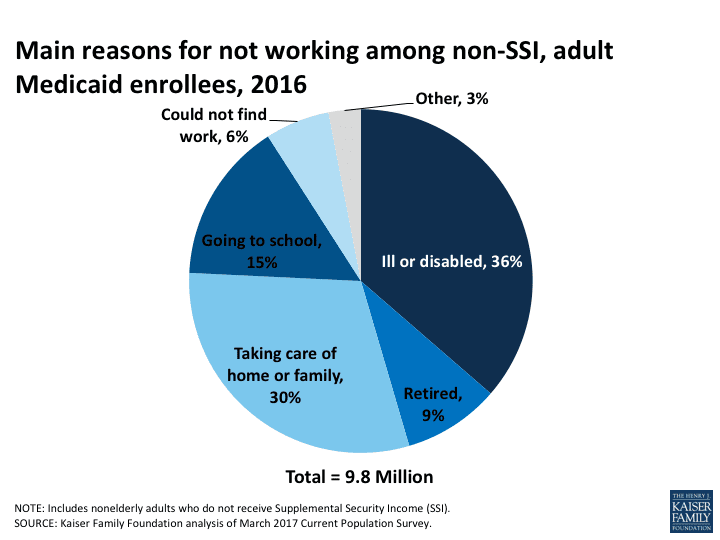
  • The notion that a work requirement for “non-aged, non-disabled” adults on Medicaid is needed at all is at odds with the reality that the substantial majority (60 percent) of adults enrolled in Medicaid today are working—more two-thirds of them full time. Thirty-two percent of the remaining adults are either ill, have a disability, are in school full time, or caring for children or an adult with a disability. Only 7 percent are “non-working” for other reasons.

#3 Full time work does not include health benefits for many Texas adults, and families headed by workers are too often still in poverty.  

  • Behind the push for adult Medicaid work requirements is the incorrect belief that gaining full-time employment will bring with it employee health benefits. A top federal Medicaid official said, “people moving off Medicaid is a good outcome because we hope that means they don’t need the program anymore.” According to the U.S. Census, 54 percent of Texans (and 59 percent of Americans) under age 65 had employer-sponsored health coverage in 2016.

#4 Several states without Medicaid Expansion have already asked federal permission to add work requirements: Kansas, Mississippi, Maine, Utah, and Wisconsin.

  • In most of the 18 states (including Texas) that have not expanded coverage, the adults facing new work requirements would be low-income parents, and former foster youth under the age of 26. It is too early to know whether states like Kansas and Mississippi, which cover only a small number of parents in Medicaid will gain federal approval to apply work requirements to such a small group in such deep poverty. But, it is important to know that some states are considering it, and it is not only “single, childless, healthy adults” who may be facing these new work policies and potential time limits.

#5 Texas Medicaid today covers only a small number of extremely poor parents.

  • In December 2017, fewer than 147,000 Texas parents in poverty received Medicaid, compared to over 3 million Texas children. Because Texas Medicaid covers only a small number of parents, and covers no poor uninsured adults without dependent children (i.e., we cover only seniors and adults with disabilities in poverty), our current Medicaid program resembles those of Alabama or Mississippi more than Maine or Wisconsin.

#6: Legality of Medicaid Work Requirements, Time Limits is in Question. 

  • Until now, imposing a work requirement has been widely believed to violate the Social Security Act requirement that section 1115 waivers must further the specific goals of the Medicaid statute, which are limited to providing health care and do not include other societal or governmental goals. The Trump administration’s CMS leadership argues that evidence of better health among employed adult Medicaid enrollees is caused by that work, and not simply a reflection that healthier enrollees have a greater ability to work.

To learn more about each of these points, read our report on why Medicaid work requirements are bad medicine for Texans.
What’s next? Stay tuned to CPPP and the Cover Texas Now coalition’s website for more updates on this issue as it affects Texans.
[1] Work requirements are not being applied to Supplemental Security Income (SSI) beneficiaries in Medicaid, which includes both people aged 65 and older in poverty, and those under 65 and in poverty with a serious disability.