
It’s easy to discuss hunger in percentages, but percentages smooth over the more than 47 million Americans, 5 million of whom live in Texas, who struggle to feed their families at various times throughout the year. Add to that the 18 million households facing very low food security, meaning they’ve skipped meals or entire days of eating.*
By acknowledging that hunger rates have remained consistent for the past three years, the USDA must also concede that its current interventions are not sufficient in curbing America’s hunger problem. Instead of taking steps to feed the country, this year Congress voted to further cut the nutrition safety net by excluding nearly 4 million Americans from the Supplemental Nutrition Assistance Program (SNAP) by expanding work requirements to formerly exempt populations: foster youth aging out of the system, caretakers of teens and aging parents, people experiencing homelessness, veterans, and seniors 55-65 who may be unable to find work.
The current federal administration ended the food security study as a cost savings measure but added new initiatives, such as increasing work requirements for food assistance and restricting what participants can purchase using SNAP funds. But, without an ongoing evaluation of steady sources of data, we cannot capture and demonstrate the effects of these initiatives.
In the absence of an ongoing federal study, we hope to see robust annual state data be conducted and tracked to propose meaningful, strategic, localized hunger solutions in our state. We urge Texas lawmakers to study food insecurity as an interim charge in order to determine whether steps taken by state lawmakers will, in fact, increase food security locally.
Explore more data on food insecurity in Texas here.
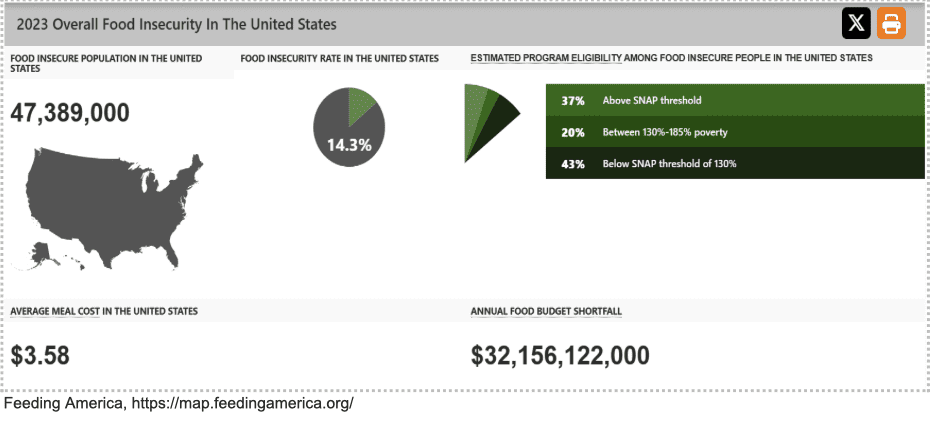
*These numbers are based on the US Census population clock as of 08 January 2026 and factored using the percentages on the report.