
Testimony to Senate Finance Committee on Data Centers
Read this testimony as a PDF. For more than 40 years, Every Texan has advocated for public policy to expand equity and opportunity for all Texans. We offer trusted research
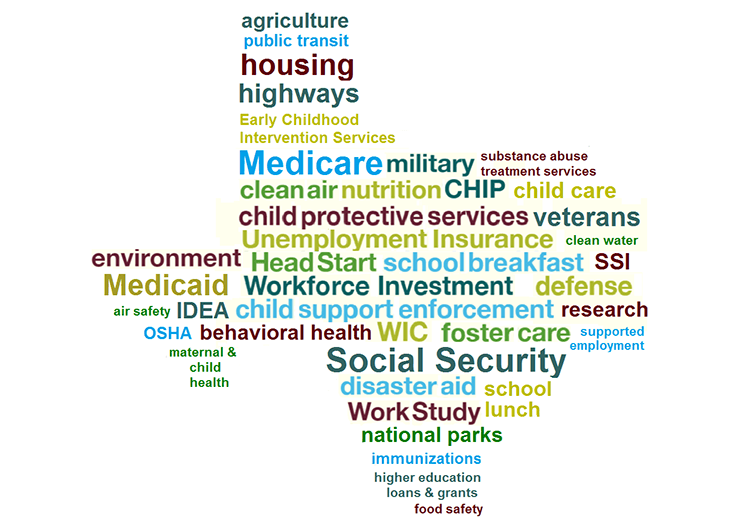
Federal dollars account for one-third of the Texas state budget.
Source: Legislative Budget Board
Federal expenditures in Texas are one and a half times as much as what our state and local government revenues pay for, combined. Federal dollars account for one-third of the Texas state budget and one-tenth of preK-12 investments.
Federal grants usually pay for one-third of the Texas state budget, the same as in most other states. Some, like Medicaid, foster care, or the Children’s Health Insurance Program require state or local dollars to be spent as “match” while others are a set amount based on state demographics. Federal aid is especially critical in state health and human services (almost 60 percent federally funded overall) and nutrition benefits (almost 100 percent federally funded).
Outside the state budget, Social Security and Medicare provide near-universal income support and access to health care for Texas seniors, while federal tax credits such as the Earned Income Tax Credit and Child Tax Credit are powerful anti-poverty tools.

Read this testimony as a PDF. For more than 40 years, Every Texan has advocated for public policy to expand equity and opportunity for all Texans. We offer trusted research

In 2024, Every Texan published the State of Working Texans, a four-part series offering an overview of the labor market with a focus on working Texans, low-income families, and people

Texas property owners pay the seventh-highest property taxes in the country. Largely because the state does not have an income tax, property taxes are essential for the services provided by our

SB 1, the state budget for the 2026-27 biennium, took effect on Sept. 1, 2025. It represents $338 billion in all funds and $149 billion in general revenue spending (the